| MOQ: | 1 |
| Price: | USD8000-USD12000/SET |
| Standard Packaging: | With regular Film and Carton |
| Delivery Period: | 15 DAYS After Deposit |
| Payment Method: | T/T |
| Supply Capacity: | 30SET/MONTH |
Full Downdraft Industrial Paint Booth | Heavy Equipment Coating Line
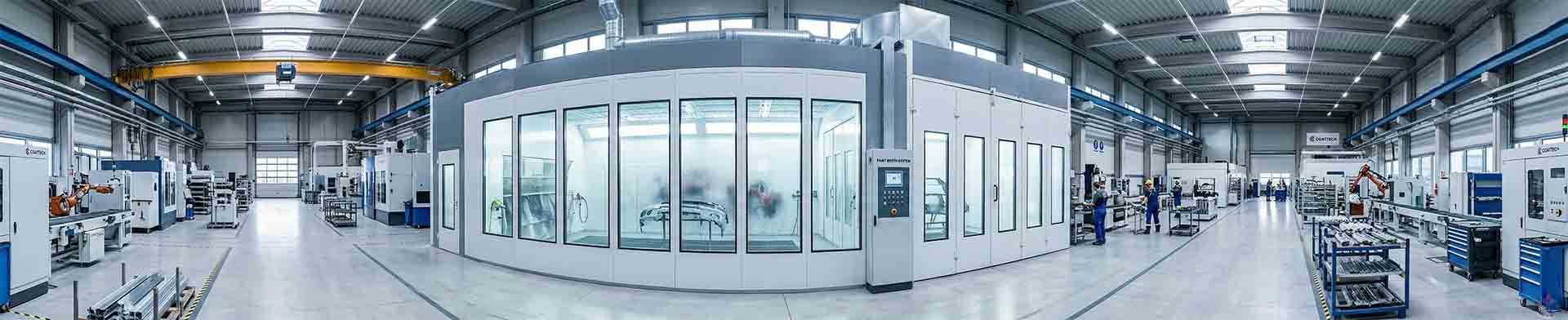
Achieve the ultimate clean finish with our Full-Downdraft Industrial Spray Booth. Features robust floor grating, massive air handling units, and uniform downward airflow.
Product Overview
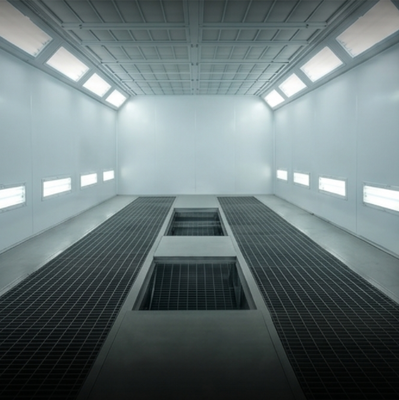
Engineered for the most demanding industrial and commercial vehicle coating applications, our Full-Downdraft Spray Booth offers the pinnacle of overspray control. Air is introduced through the ceiling plenum and flows straight down over the workpiece, exhausting through the sub-floor pit and grated flooring. Paired with a massive, independent air handling unit (AHU), this system provides unparalleled air purity and operator safety for continuous production lines.
Key Features
1.True Downdraft Airflow: Ensures overspray and fumes are immediately pulled downward and away from the operator and the painted surface.
2.Heavy-Duty Floor Grating: Fully grated floor mounted over an exhaust pit, constructed with reinforced galvanized steel to support heavy machinery and vehicles.
3.High-Capacity Air Handling Unit (AHU): Exterior-mounted generator unit houses oversized burners, heat exchangers, and dual-fan systems for massive air volume turnover.
4.Comprehensive Ductwork: Modular galvanized steel ducting ensures efficient air intake and secure exhaust discharge, complying with strict environmental regulations.
Technical Specifications
| Parameter | Specification |
| Airflow Type | Full Downdraft (Ceiling to Floor) |
| Base Configuration | Concrete Pit Exhaust (Custom pit drawings provided) |
| Floor Grating | Full Grid, Galvanized Steel (Load Capacity: 3-5 Tons/Wheel) |
| Heat Exchanger | SUS304 Stainless Steel (Argon Arc Welded) |
| Burner Options | Riello Diesel / Gas Burner (Up to 260,000 kcal/h) |
| Total Power Consumption | 15 kW - 30 kW (Depending on configuration) |
| Noise Level | ≤ 80 dB |
| Suitability | Commercial vehicles, heavy industrial machinery, long production lines |
See It In Action:
Seeing is believing. Check out our detailed step-by-step video guide to see how efficiently a CoatTech spray booth is assembled on-site through Youtube Video
Frequently Asked Questions (FAQ)
Q1: What are the primary advantages of combining a downdraft system with infrared curing lamps?
A: This combination offers the ultimate environment for a flawless finish. The full downdraft airflow continuously pulls airborne dust and overspray straight down into the floor filters, away from your paint job. Meanwhile, the shortwave infrared lamps cure the paint from the inner layers outward. This prevents "skinning" (where the surface dries first, trapping solvents underneath), minimizes the risk of pop-boiling, and cuts your overall baking time in half compared to traditional hot-air convection booths.
Q2: Can the wall-mounted infrared heating zones be controlled independently?
A: Yes. The integrated infrared heating system is segmented into multiple independent zones controllable via the main panel. For smaller panels, spot repairs, or bumper touch-ups, operators can activate only the specific heating zones required. This targeted curing significantly reduces power consumption and lowers operating costs.
Q3: Is this spray booth fully compatible with waterborne paint systems?
A: Absolutely. Waterborne paints require precise, uniform airflow and controlled thermal energy to break the water barrier efficiently. The combination of clean, high-velocity laminar downdraft air and direct, shortwave infrared radiant heat ensures exceptionally rapid water evaporation and cross-linking, making it highly effective for both solvent-based and waterborne paint lines.
Q4: What is the recommended maintenance schedule for the filter elements?
A: To maintain optimal cabin pressure and a pristine, dust-free environment, we recommend the following replacement intervals under normal operating conditions:
1.Pre-Filters (Intake Air): Every 100 working hours.
2.Ceiling Fine Filters: Every 400 to 500 working hours.
3.Floor Paint-Stop Filters (Glass Fiber): Every 80 to 100 working hours, or when visible overspray accumulation slows down the exhaust airflow.
Here is the Youtube Link video for your reference
https://youtube.com/shorts/B3tQHiFbkC8?feature=share
![]()
![]()
![]()
![]()
| MOQ: | 1 |
| Price: | USD8000-USD12000/SET |
| Standard Packaging: | With regular Film and Carton |
| Delivery Period: | 15 DAYS After Deposit |
| Payment Method: | T/T |
| Supply Capacity: | 30SET/MONTH |
Full Downdraft Industrial Paint Booth | Heavy Equipment Coating Line
Achieve the ultimate clean finish with our Full-Downdraft Industrial Spray Booth. Features robust floor grating, massive air handling units, and uniform downward airflow.
Product Overview
Engineered for the most demanding industrial and commercial vehicle coating applications, our Full-Downdraft Spray Booth offers the pinnacle of overspray control. Air is introduced through the ceiling plenum and flows straight down over the workpiece, exhausting through the sub-floor pit and grated flooring. Paired with a massive, independent air handling unit (AHU), this system provides unparalleled air purity and operator safety for continuous production lines.
Key Features
1.True Downdraft Airflow: Ensures overspray and fumes are immediately pulled downward and away from the operator and the painted surface.
2.Heavy-Duty Floor Grating: Fully grated floor mounted over an exhaust pit, constructed with reinforced galvanized steel to support heavy machinery and vehicles.
3.High-Capacity Air Handling Unit (AHU): Exterior-mounted generator unit houses oversized burners, heat exchangers, and dual-fan systems for massive air volume turnover.
4.Comprehensive Ductwork: Modular galvanized steel ducting ensures efficient air intake and secure exhaust discharge, complying with strict environmental regulations.
Technical Specifications
| Parameter | Specification |
| Airflow Type | Full Downdraft (Ceiling to Floor) |
| Base Configuration | Concrete Pit Exhaust (Custom pit drawings provided) |
| Floor Grating | Full Grid, Galvanized Steel (Load Capacity: 3-5 Tons/Wheel) |
| Heat Exchanger | SUS304 Stainless Steel (Argon Arc Welded) |
| Burner Options | Riello Diesel / Gas Burner (Up to 260,000 kcal/h) |
| Total Power Consumption | 15 kW - 30 kW (Depending on configuration) |
| Noise Level | ≤ 80 dB |
| Suitability | Commercial vehicles, heavy industrial machinery, long production lines |
See It In Action:
Seeing is believing. Check out our detailed step-by-step video guide to see how efficiently a CoatTech spray booth is assembled on-site through Youtube Video
Frequently Asked Questions (FAQ)
Q1: What are the primary advantages of combining a downdraft system with infrared curing lamps?
A: This combination offers the ultimate environment for a flawless finish. The full downdraft airflow continuously pulls airborne dust and overspray straight down into the floor filters, away from your paint job. Meanwhile, the shortwave infrared lamps cure the paint from the inner layers outward. This prevents "skinning" (where the surface dries first, trapping solvents underneath), minimizes the risk of pop-boiling, and cuts your overall baking time in half compared to traditional hot-air convection booths.
Q2: Can the wall-mounted infrared heating zones be controlled independently?
A: Yes. The integrated infrared heating system is segmented into multiple independent zones controllable via the main panel. For smaller panels, spot repairs, or bumper touch-ups, operators can activate only the specific heating zones required. This targeted curing significantly reduces power consumption and lowers operating costs.
Q3: Is this spray booth fully compatible with waterborne paint systems?
A: Absolutely. Waterborne paints require precise, uniform airflow and controlled thermal energy to break the water barrier efficiently. The combination of clean, high-velocity laminar downdraft air and direct, shortwave infrared radiant heat ensures exceptionally rapid water evaporation and cross-linking, making it highly effective for both solvent-based and waterborne paint lines.
Q4: What is the recommended maintenance schedule for the filter elements?
A: To maintain optimal cabin pressure and a pristine, dust-free environment, we recommend the following replacement intervals under normal operating conditions:
1.Pre-Filters (Intake Air): Every 100 working hours.
2.Ceiling Fine Filters: Every 400 to 500 working hours.
3.Floor Paint-Stop Filters (Glass Fiber): Every 80 to 100 working hours, or when visible overspray accumulation slows down the exhaust airflow.
Here is the Youtube Link video for your reference
https://youtube.com/shorts/B3tQHiFbkC8?feature=share
![]()
![]()
![]()
![]()