| MOQ: | 1 |
| Price: | USD11000-USD25000/SET |
| Standard Packaging: | With regular Film and Carton |
| Delivery Period: | 15 DAYS After Deposit |
| Payment Method: | T/T |
| Supply Capacity: | 30SET/MONTH |
Inside a Large Industrial Spray Booth — Wall Panels, LED Lighting Array, Roller Shutter Doors & Extraction Package
01 OVERVIEW
What determines the quality of a paint finish is not the outside of the booth. It is what happens inside: how evenly the air moves, how well the space is lit, how clean the wall surfaces stay, and how the operator moves through the enclosure.
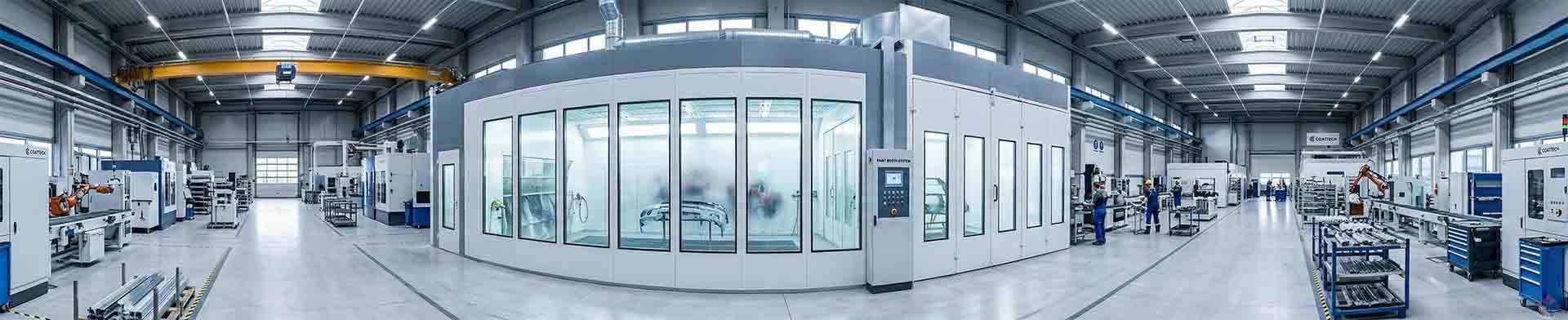
This page sets out the interior configuration of a CoatTech large industrial spray booth — the wall panel system, the lighting array, the door arrangement and the extraction package — and explains what each one does and why it is specified the way it is.
The booth shown here is configured for large and long workpieces, including structural steelwork, pipe work and fabricated assemblies. Every element of the interior is engineered to the workpiece and the coating being applied, not assembled from a fixed catalogue.
![]()
02 WALL PANELS AND CEILING LIGHTING
SMOOTH, WASHABLE WALL PANELS
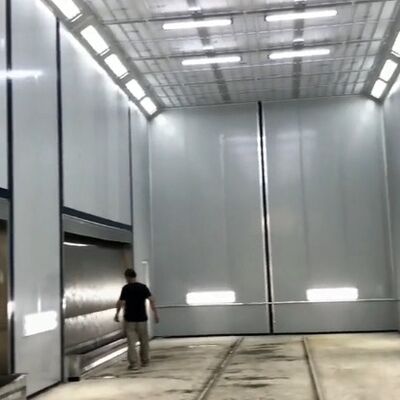
The interior walls are clad in smooth-faced metal panels with a black framed joint system between them. The smooth face matters for one reason: overspray that lands on a rough or profiled surface is difficult to remove, and the residue it leaves behind becomes a dust source that contaminates the next job.
A smooth panel can be washed down. Overspray does not build into a flaking layer that eventually sheds particles into the airflow. In a booth that runs every day, this is the difference between a wall that stays clean and one that quietly degrades finish quality over months.
The panel joints are framed rather than simply butted, which keeps the wall line true over a long span and gives a clean edge at every panel change.
CEILING-MOUNTED LED LIGHTING ARRAY
Lighting is arranged as multiple rows of linear LED fixtures across the ceiling rather than as a few point sources. The reason is shadowing. An operator spraying a large, three-dimensional assembly needs to see into recesses, along flanges and behind brackets; a single bright source throws a hard shadow behind every obstruction.
A distributed array flattens those shadows and gives even illumination across the full working height. This is not only a comfort issue — colour matching, coverage checks and defect detection all depend on the operator being able to see the surface accurately while the coating is still wet.
LED fixtures are used both for their output per watt and because they run cool, which matters in an enclosed space where temperature affects coating behaviour.
![]()
03 DOORS, VENTILATION AND THE OPERATOR
ROLLER SHUTTER AND SLIDING DOOR ARRANGEMENTS
Large booths need large openings, and a swinging door of that size is impractical — it needs clear floor space in front of it and it cannot seal reliably across a wide span. Roller shutter and sliding door arrangements solve both problems: they open vertically or laterally along the building line, they need no clearance in front of the booth, and they seal against a fixed frame.
For long workpieces, door openings are sized to the workpiece rather than to a standard, so that a long assembly can pass through without being angled or tilted.
EXTRACTION AND AIR HANDLING
The extraction package sits alongside the booth and connects through ducting to the booth interior. Drawing air through the booth and out via filtration is what removes overspray from the operator's breathing zone and keeps the atmosphere inside the enclosure within safe limits when solvent-based coatings are used.
Airflow is specified from the booth volume and the required air change rate, not from a fan catalogue. Undersized extraction shows up as slow clearance of overspray and poor visibility; oversized extraction wastes heating energy and can disturb the spray pattern. CoatTech sizes the package to the actual enclosure and coating.
THE OPERATOR INSIDE THE BOOTH
The final element of the interior is the person working in it. A large booth is a workspace, and it has to be laid out so that an operator can move around a large assembly, reach all faces, and see what they are doing — while wearing the respiratory protection and clothing the coating requires.
That means clearance around the workpiece, lighting positioned so the operator does not work in their own shadow, and extraction that pulls overspray away from them rather than across them. A booth that looks impressive but is awkward to work in produces worse finishes than a simpler one that is laid out properly.
![]()
04 SPECIFICATIONS
|
Parameter |
Specification |
|
Booth type |
Large industrial spray booth |
|
Internal dimensions |
【confirm L x W x H in mm】 |
|
Wall system |
Smooth-faced metal wall panels with framed joints, washable finish |
|
Lighting |
Multiple rows of ceiling-mounted linear LED fixtures 【confirm lux at working height】 |
|
Door arrangement |
Roller shutter / sliding doors, opening sized to workpiece 【confirm dimensions】 |
|
Extraction |
Ducted extraction package with filtration 【confirm airflow in m3/h】 |
|
Workpiece |
Large and long assemblies — structural steelwork, pipe work, fabricated components |
|
Operator access |
Full walk-in clearance around the workpiece |
|
Customisation |
Interior layout, lighting density, door position and extraction capacity engineered to the workpiece and coating |
![]()
05 FREQUENTLY ASKED QUESTIONS
Q: What is inside an industrial spray booth?
A: Four systems working together: the wall and ceiling surfaces that enclose the space, the lighting array that lets the operator see the work, the door arrangement that lets large workpieces in and out, and the extraction package that removes overspray and filtered air. The quality of the finish depends on all four, not only on the spray equipment.
Q: How much lighting does a spray booth need?
A: Enough that the operator can assess colour and coverage accurately while the coating is still wet, without hard shadows behind the workpiece. In practice this is achieved with multiple distributed fixtures rather than one bright source, because a single point source throws a shadow behind every obstruction on a large assembly. The required level depends on the coating and the inspection standard; CoatTech specifies lighting density to the application.
Q: What are spray booth wall panels made of?
A: Smooth-faced metal panels with a framed joint system. The smooth face is deliberate: overspray lands on it and can be washed off, rather than building into a layer that sheds dust into the airflow and contaminates the next job.
Q: Why do large spray booths use roller shutter or sliding doors?
A: A swinging door large enough for a long assembly needs clear floor space in front of the booth and cannot seal reliably across a wide span. Roller shutter and sliding arrangements open along the building line, need no clearance in front, and seal against a fixed frame. Openings are sized to the workpiece rather than to a standard.
Q: How is spray booth ventilation sized?
A: From the booth volume and the required air change rate, then checked against the coating and the solvent load. Undersized extraction leaves overspray hanging in the air and reduces visibility; oversized extraction wastes heating energy and can disturb the spray pattern. It is a calculation, not a fan selection.
Q: Can the interior be configured for different workpiece sizes?
A: Yes. Interior layout, door opening size and position, lighting density and extraction capacity are all engineered to the workpiece. A booth built for structural steelwork is laid out differently from one built for long pipe work, even at similar overall dimensions.
Q: What should I specify when ordering?
A: Maximum workpiece dimensions and weight, coating type with TDS/MSDS, required finish standard, production throughput and shift pattern, available floor area and door access, and the utilities available at your site. CoatTech will return an interior layout and a budgetary proposal.
here the Youtube Link for your reference.
https://youtube.com/shorts/L3LgIGAeZpc?feature=share
![]()
![]()
![]()