| MOQ: | 1 |
| Price: | USD8000-USD12000/SET |
| Standard Packaging: | With regular Film and Carton |
| Delivery Period: | 15 DAYS After Deposit |
| Payment Method: | T/T |
| Supply Capacity: | 30SET/MONTH |
Automated Panel Reciprocating Spray Coating Line
Gantry XY Reciprocator | Powered Roller Infeed | Enclosed Dry-Filter Spray Cabin | Manual Touch-Up Station
01 AT A GLANCE
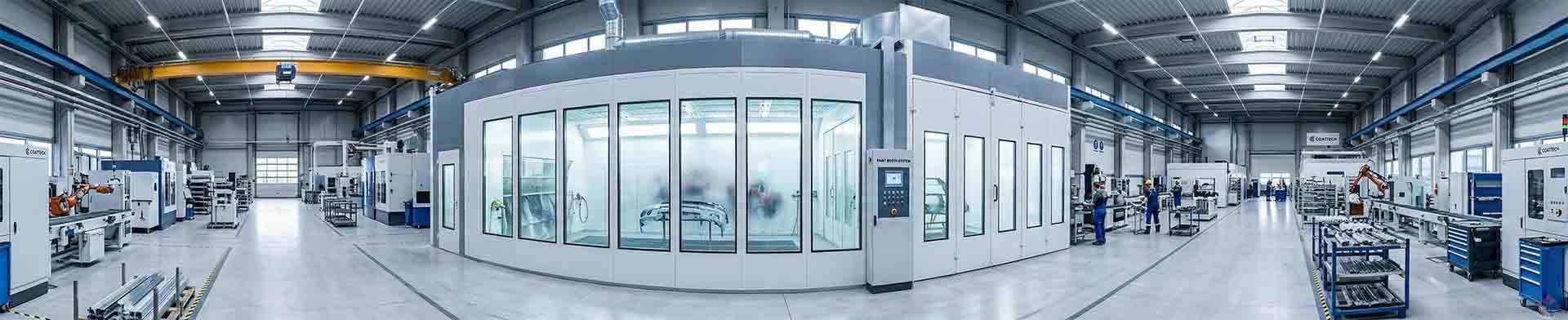
An automated panel reciprocating spray coating line is a finishing system in which large flat panels are carried into an enclosed cabin on a powered roller conveyor, held on a pin-type support table, and coated by a spray gun mounted on an overhead gantry that scans the full panel surface in a programmed XY pattern. Overspray is pulled down through a dry filter bed beneath the table, and a manual station at the exit handles edges, returns and local inspection.
It is built for one specific job that general-purpose spray booths handle badly: applying an even, repeatable film across a wide, flat, horizontal surface, panel after panel, without an operator having to sweep a gun across it by hand.
|
CORE MODULE |
WHAT IT DOES |
WHAT IT GIVES THE BUYER |
|
01 Powered roller conveyor |
Carries large panels smoothly into and out of the cabin and interfaces with the support table |
Stable infeed, no manual lifting, repeatable panel position |
|
02 Enclosed spray cabin with gantry XY reciprocator |
Programmed gun path over the full panel; down-draft extraction through pleated dry filter media |
Uniform film thickness, contained paint mist, clean workshop air |
|
03 Manual inspection and touch-up station |
Operator checks edges, returns and local defects after the automatic pass |
Batch throughput without losing control of detail quality |
IN ONE SENTENCE The conveyor positions the panel, the gantry coats the face, the dry filter takes the overspray, and the operator only handles what the machine cannot see.
![]()
02 WHAT THIS LINE IS — AND WHAT IT IS NOT
Three names are regularly confused in this part of the industry. The distinction matters when you are comparing quotations, because the equipment and the finish are not interchangeable.
|
OFTEN CONFUSED WITH |
THE ACTUAL DIFFERENCE |
|
Roller coating line |
A roller coating line transfers coating onto a panel with a set of application rollers — the roller touches the surface. This line uses a spray gun that never touches the panel; the rollers here are only a conveyor. The names sound similar and the process is entirely different. |
|
Water curtain spray booth |
A water curtain booth washes overspray into a flowing water film on the rear wall. This cabin uses a dry, pleated filter bed directly beneath the working table with down-draft extraction. There is no water circuit, no sludge and no wastewater. |
|
Standard reciprocator unit |
A standalone reciprocator is one machine that moves a gun up and down beside a passing part. Here the reciprocator is a two-axis gantry that travels across a horizontal panel, and it is integrated with the conveyor, extraction, filtration and control into one line. |
ON VOCs The cabin contains and captures paint mist. VOC treatment — activated carbon, catalytic oxidation or thermal oxidation — is a separate downstream module specified to the coating and to local emissions rules. It is not part of the standard cabin. CoatTech will state explicitly what is included in your quotation rather than leaving the boundary unclear.
![]()
03 THE THREE CORE MODULES
3.1 POWERED ROLLER CONVEYOR — STABLE INFEED FOR LARGE PANELS
Large panels are heavy, flexible and easy to mark. The infeed is a powered roller bed that carries the panel into the cabin at a controlled speed and hands it over to the support table without a lift, a tilt or a manual push. Roller pitch, width and drive are set to the minimum panel size, so that short panels are still supported by enough rollers to stay flat.
A compressed air receiver is positioned beside the infeed to give the spray guns a stable, dry supply. Pressure fluctuation at the gun shows up immediately as variation in film build, so the air supply is treated as part of the coating process, not as a workshop utility.
3.2 ENCLOSED CABIN AND GANTRY XY RECIPROCATOR
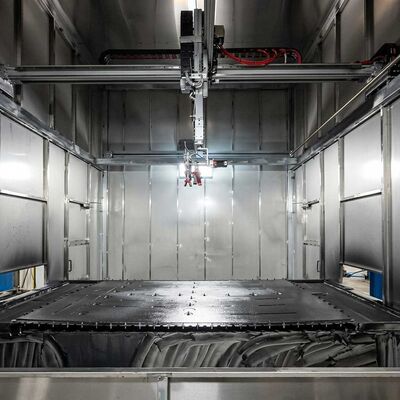
The cabin is fully enclosed in smooth stainless steel panels, with ceiling lighting arranged to give even illumination across the whole working area. A two-axis gantry spans the cabin: a horizontal beam travels the length of the panel, and a vertical Z axis carries the spray head down to a fixed stand-off. A cable carrier manages the hoses and wiring so that nothing hangs into the spray path.
The gun follows a programmed serpentine path, and each pass overlaps the previous one by a set amount. Panel width, path pitch, traverse speed, gun output and stand-off are stored together as a recipe. That is what makes the first panel of a shift and the last panel of a shift come out with the same film thickness — a result a hand-held gun cannot repeat.
The panel rests on a stainless steel support table covered with small pin-type supports. The pins hold the panel clear of the table surface, reduce contact marks on the reverse face, and allow air and overspray to pass to the edges rather than being trapped beneath the panel.
3.3 DRY FILTER BED AND DOWN-DRAFT EXTRACTION
Beneath the working table is a deep bed of pleated dry filter media, mounted in a pull-out drawer. Extraction pulls air downward through the panel zone and into the filter, so overspray travels away from the operator and away from the freshly coated face instead of drifting back up into the room.
Pleated media gives a large filter area in a shallow depth, which keeps the pressure drop low for longer and extends the interval between changes. Because it is dry, there is no water pump, no tank, no sludge handling and no wastewater. Spent media is removed as solid waste in accordance with local rules.
WHY DOWN-DRAFT On a horizontal panel, downward airflow is the only direction that does not blow across the wet film. It is the single most important reason this cabin holds a clean finish on a wide flat surface.
3.4 MANUAL INSPECTION AND TOUCH-UP STATION
Automatic scanning covers the face. It cannot reliably see a returned edge, a recessed profile, a cut-out or a shaped corner. A manned station at the exit keeps an operator in a full protective suit with a local touch-up gun and a shield, so edges and returns are corrected while the coating is still workable.
This is deliberately a hybrid, not a fully unmanned line. It gives the throughput of an automatic pass on the large flat area while keeping human judgement on exactly the features that automation misses — which is usually where complaints about a panel finish originate.
04 CORE SELLING POINTS
|
# |
SELLING POINT |
WHY IT MATTERS |
|
01 |
Even film across a wide flat face |
Programmed XY path with fixed stand-off and controlled overlap removes the banding and thin ends that hand spraying leaves on large panels |
|
02 |
Repeatable, recipe-based production |
Traverse speed, gun output, panel width and path pitch are stored as a recipe, so a proven setting can be recalled exactly on the next batch |
|
03 |
Panels stay flat and unmarked |
Powered roller infeed plus pin-type support means no manual lifting, no sagging on a wide span and minimal contact on the reverse face |
|
04 |
Clean finish on light colours |
Down-draft extraction pulls overspray away from the wet surface, which is what keeps white and pale finishes free of specks |
|
05 |
No water, no sludge, no wastewater |
Dry pleated filter media simplifies operation and removes the pump, tank, chemical dosing and sludge disposal of a wet system |
|
06 |
Automation where it pays, people where it counts |
The gantry handles the large area; the operator handles edges, returns and defects. Throughput and detail quality are not traded against each other |
|
07 |
Enclosed and contained |
Stainless steel cabin keeps paint mist inside the working zone and protects the surrounding workshop and adjacent processes |
05 PARAMETERS & SPECIFICATIONS
The table below gives the configuration and the parameters CoatTech engineers to order. Values that depend on the actual panel or coating are stated as engineered-to-order rather than quoted as a fixed number, so that the specification you receive with your quotation matches the equipment that is built.
|
PARAMETER |
SPECIFICATION |
|
System type |
Automated panel reciprocating spray coating line |
|
Application method |
Spray gun on a two-axis overhead gantry — non-contact application |
|
Workpiece |
Large flat panels — metal sheet, furniture and cabinet panels, composite and decorative boards |
|
Panel size and weight |
Engineered to the workpiece — confirm maximum L x W, thickness and weight at quotation |
|
Infeed / outfeed |
Powered roller conveyor, roller pitch and width set to the minimum panel size |
|
Panel support |
Stainless steel table with pin-type supports, holding the panel clear of the surface |
|
Reciprocator |
Gantry XY with vertical Z axis, fixed stand-off, hose and cable carrier |
|
Gun path |
Programmed serpentine scan with controlled pass overlap, stored as a recipe |
|
Spray head |
Single or multi-gun head configured to panel width and coating — confirm at quotation |
|
Compressed air |
Dedicated receiver with filtration and pressure regulation at the infeed |
|
Cabin |
Fully enclosed, smooth stainless steel wall and ceiling panels |
|
Airflow direction |
Down-draft through the working table into the filter bed |
|
Overspray capture |
Pleated dry filter media in a pull-out drawer beneath the table |
|
Extraction |
Sized from the working area and required capture velocity — confirm m3/h at quotation |
|
Lighting |
Ceiling-mounted, even illumination across the full working area |
|
Manual station |
Operator position with local touch-up gun and shield for edges and returns |
|
Control |
Recipe-based control of conveyor, gantry path, gun triggering and extraction |
|
Power supply |
Specified to the destination country |
|
VOC treatment |
Separate downstream module (activated carbon / catalytic / thermal), specified where local rules require it |
|
Downstream |
Flash-off and curing or drying section sized to the panel — supplied as an integrated option |
|
Customisation |
Cabin width, gantry stroke, table pin layout, filter area, conveyor length and control scope engineered per order |
SPECIFICATION POLICY Every figure in a CoatTech proposal is tied to your panel and your coating. If a parameter cannot be stated for your configuration, it is marked as such — it is not filled with a number borrowed from another project.
![]()
06 TYPICAL APPLICATIONS
· Furniture and cabinet panels, doors and shelving boards
· Metal sheets, enclosures and architectural cladding panels
· Composite, laminated and decorative boards
· Appliance panels and flat housings
· Any flat component where a light-coloured or high-cosmetic finish has to be repeatable across a production run
For three-dimensional parts, long profiles or very low volumes with frequent colour changes, a different booth configuration will usually serve you better. CoatTech will tell you so at the layout stage.
07 FREQUENTLY ASKED QUESTIONS
Q1 Is this the same as a roller coating line?
A No. A roller coating line applies coating with application rollers that touch the panel. Here the rollers are only a conveyor — the coating is applied by a spray gun on a gantry that never touches the surface. The two names are easy to confuse, but the equipment, the finish and the maintenance are completely different.
Q2 Is this a water curtain booth?
A No. There is no water film and no water circuit. Overspray is pulled downward into a pleated dry filter bed beneath the working table. That means no pump, no tank, no chemical dosing, no sludge and no wastewater.
Q3 Why use a gantry instead of a side-mounted reciprocator?
A A side reciprocator moves a gun up and down beside a vertical part. A horizontal panel needs the gun to travel across the whole surface in two axes. The gantry scans the face in a programmed path with a fixed stand-off, which is what produces even film build over a wide flat area.
Q4 How does the line keep film thickness consistent?
A Traverse speed, path pitch, pass overlap, gun output and stand-off are set together and stored as a recipe. Changing one in isolation is the usual cause of banding. Once a setting is proven, the line repeats it on every panel, which removes the variation that comes with a hand-held gun.
Q5 What are the small pins on the support table for?
A They hold the panel clear of the table surface. That reduces contact marks on the reverse face and allows air and overspray to move to the edges and down into the filter instead of being trapped under the panel.
Q6 Does the standard cabin include VOC treatment?
A The cabin contains and captures paint mist through dry filtration. VOC abatement is a separate downstream module — activated carbon, catalytic oxidation or thermal oxidation — specified to the coating and to your local emissions rules. CoatTech states the boundary clearly in the quotation.
Q7 Why keep a manual station on an automatic line?
A Because an automatic scan sees the face, not a returned edge, a recessed profile or a cut-out. The manual station puts an operator on exactly those features while the coating is still workable. It is a deliberate hybrid: automation for throughput, human judgement for detail.
Q8 What information do you need to quote?
A Panel dimensions, thickness and weight, substrate, coating specification with TDS and MSDS, target film thickness, required panels per shift, colour-change frequency, available floor space and ceiling height, and the utilities at your site. CoatTech will return a line layout and a budgetary proposal.
08 TALK TO OUR ENGINEERING TEAM
Send us your panel drawings, coating specification and target output. We will return a line layout covering conveyor interface, gantry stroke and path, filter area, extraction and downstream curing, with a budgetary proposal — including an honest answer on whether an automatic gantry line is justified for your volume.
Youtube Video Link
https://youtube.com/shorts/KbKCrLAEN9M?feature=share
![]()
![]()
Contact Tim, Overseas Marketing & Sales Manager,
to discuss your custom spray booth requirements and secure a technical consultation.
![]()
|
|
| MOQ: | 1 |
| Price: | USD8000-USD12000/SET |
| Standard Packaging: | With regular Film and Carton |
| Delivery Period: | 15 DAYS After Deposit |
| Payment Method: | T/T |
| Supply Capacity: | 30SET/MONTH |
Automated Panel Reciprocating Spray Coating Line
Gantry XY Reciprocator | Powered Roller Infeed | Enclosed Dry-Filter Spray Cabin | Manual Touch-Up Station
01 AT A GLANCE
An automated panel reciprocating spray coating line is a finishing system in which large flat panels are carried into an enclosed cabin on a powered roller conveyor, held on a pin-type support table, and coated by a spray gun mounted on an overhead gantry that scans the full panel surface in a programmed XY pattern. Overspray is pulled down through a dry filter bed beneath the table, and a manual station at the exit handles edges, returns and local inspection.
It is built for one specific job that general-purpose spray booths handle badly: applying an even, repeatable film across a wide, flat, horizontal surface, panel after panel, without an operator having to sweep a gun across it by hand.
|
CORE MODULE |
WHAT IT DOES |
WHAT IT GIVES THE BUYER |
|
01 Powered roller conveyor |
Carries large panels smoothly into and out of the cabin and interfaces with the support table |
Stable infeed, no manual lifting, repeatable panel position |
|
02 Enclosed spray cabin with gantry XY reciprocator |
Programmed gun path over the full panel; down-draft extraction through pleated dry filter media |
Uniform film thickness, contained paint mist, clean workshop air |
|
03 Manual inspection and touch-up station |
Operator checks edges, returns and local defects after the automatic pass |
Batch throughput without losing control of detail quality |
IN ONE SENTENCE The conveyor positions the panel, the gantry coats the face, the dry filter takes the overspray, and the operator only handles what the machine cannot see.
![]()
02 WHAT THIS LINE IS — AND WHAT IT IS NOT
Three names are regularly confused in this part of the industry. The distinction matters when you are comparing quotations, because the equipment and the finish are not interchangeable.
|
OFTEN CONFUSED WITH |
THE ACTUAL DIFFERENCE |
|
Roller coating line |
A roller coating line transfers coating onto a panel with a set of application rollers — the roller touches the surface. This line uses a spray gun that never touches the panel; the rollers here are only a conveyor. The names sound similar and the process is entirely different. |
|
Water curtain spray booth |
A water curtain booth washes overspray into a flowing water film on the rear wall. This cabin uses a dry, pleated filter bed directly beneath the working table with down-draft extraction. There is no water circuit, no sludge and no wastewater. |
|
Standard reciprocator unit |
A standalone reciprocator is one machine that moves a gun up and down beside a passing part. Here the reciprocator is a two-axis gantry that travels across a horizontal panel, and it is integrated with the conveyor, extraction, filtration and control into one line. |
ON VOCs The cabin contains and captures paint mist. VOC treatment — activated carbon, catalytic oxidation or thermal oxidation — is a separate downstream module specified to the coating and to local emissions rules. It is not part of the standard cabin. CoatTech will state explicitly what is included in your quotation rather than leaving the boundary unclear.
![]()
03 THE THREE CORE MODULES
3.1 POWERED ROLLER CONVEYOR — STABLE INFEED FOR LARGE PANELS
Large panels are heavy, flexible and easy to mark. The infeed is a powered roller bed that carries the panel into the cabin at a controlled speed and hands it over to the support table without a lift, a tilt or a manual push. Roller pitch, width and drive are set to the minimum panel size, so that short panels are still supported by enough rollers to stay flat.
A compressed air receiver is positioned beside the infeed to give the spray guns a stable, dry supply. Pressure fluctuation at the gun shows up immediately as variation in film build, so the air supply is treated as part of the coating process, not as a workshop utility.
3.2 ENCLOSED CABIN AND GANTRY XY RECIPROCATOR
The cabin is fully enclosed in smooth stainless steel panels, with ceiling lighting arranged to give even illumination across the whole working area. A two-axis gantry spans the cabin: a horizontal beam travels the length of the panel, and a vertical Z axis carries the spray head down to a fixed stand-off. A cable carrier manages the hoses and wiring so that nothing hangs into the spray path.
The gun follows a programmed serpentine path, and each pass overlaps the previous one by a set amount. Panel width, path pitch, traverse speed, gun output and stand-off are stored together as a recipe. That is what makes the first panel of a shift and the last panel of a shift come out with the same film thickness — a result a hand-held gun cannot repeat.
The panel rests on a stainless steel support table covered with small pin-type supports. The pins hold the panel clear of the table surface, reduce contact marks on the reverse face, and allow air and overspray to pass to the edges rather than being trapped beneath the panel.
3.3 DRY FILTER BED AND DOWN-DRAFT EXTRACTION
Beneath the working table is a deep bed of pleated dry filter media, mounted in a pull-out drawer. Extraction pulls air downward through the panel zone and into the filter, so overspray travels away from the operator and away from the freshly coated face instead of drifting back up into the room.
Pleated media gives a large filter area in a shallow depth, which keeps the pressure drop low for longer and extends the interval between changes. Because it is dry, there is no water pump, no tank, no sludge handling and no wastewater. Spent media is removed as solid waste in accordance with local rules.
WHY DOWN-DRAFT On a horizontal panel, downward airflow is the only direction that does not blow across the wet film. It is the single most important reason this cabin holds a clean finish on a wide flat surface.
3.4 MANUAL INSPECTION AND TOUCH-UP STATION
Automatic scanning covers the face. It cannot reliably see a returned edge, a recessed profile, a cut-out or a shaped corner. A manned station at the exit keeps an operator in a full protective suit with a local touch-up gun and a shield, so edges and returns are corrected while the coating is still workable.
This is deliberately a hybrid, not a fully unmanned line. It gives the throughput of an automatic pass on the large flat area while keeping human judgement on exactly the features that automation misses — which is usually where complaints about a panel finish originate.
04 CORE SELLING POINTS
|
# |
SELLING POINT |
WHY IT MATTERS |
|
01 |
Even film across a wide flat face |
Programmed XY path with fixed stand-off and controlled overlap removes the banding and thin ends that hand spraying leaves on large panels |
|
02 |
Repeatable, recipe-based production |
Traverse speed, gun output, panel width and path pitch are stored as a recipe, so a proven setting can be recalled exactly on the next batch |
|
03 |
Panels stay flat and unmarked |
Powered roller infeed plus pin-type support means no manual lifting, no sagging on a wide span and minimal contact on the reverse face |
|
04 |
Clean finish on light colours |
Down-draft extraction pulls overspray away from the wet surface, which is what keeps white and pale finishes free of specks |
|
05 |
No water, no sludge, no wastewater |
Dry pleated filter media simplifies operation and removes the pump, tank, chemical dosing and sludge disposal of a wet system |
|
06 |
Automation where it pays, people where it counts |
The gantry handles the large area; the operator handles edges, returns and defects. Throughput and detail quality are not traded against each other |
|
07 |
Enclosed and contained |
Stainless steel cabin keeps paint mist inside the working zone and protects the surrounding workshop and adjacent processes |
05 PARAMETERS & SPECIFICATIONS
The table below gives the configuration and the parameters CoatTech engineers to order. Values that depend on the actual panel or coating are stated as engineered-to-order rather than quoted as a fixed number, so that the specification you receive with your quotation matches the equipment that is built.
|
PARAMETER |
SPECIFICATION |
|
System type |
Automated panel reciprocating spray coating line |
|
Application method |
Spray gun on a two-axis overhead gantry — non-contact application |
|
Workpiece |
Large flat panels — metal sheet, furniture and cabinet panels, composite and decorative boards |
|
Panel size and weight |
Engineered to the workpiece — confirm maximum L x W, thickness and weight at quotation |
|
Infeed / outfeed |
Powered roller conveyor, roller pitch and width set to the minimum panel size |
|
Panel support |
Stainless steel table with pin-type supports, holding the panel clear of the surface |
|
Reciprocator |
Gantry XY with vertical Z axis, fixed stand-off, hose and cable carrier |
|
Gun path |
Programmed serpentine scan with controlled pass overlap, stored as a recipe |
|
Spray head |
Single or multi-gun head configured to panel width and coating — confirm at quotation |
|
Compressed air |
Dedicated receiver with filtration and pressure regulation at the infeed |
|
Cabin |
Fully enclosed, smooth stainless steel wall and ceiling panels |
|
Airflow direction |
Down-draft through the working table into the filter bed |
|
Overspray capture |
Pleated dry filter media in a pull-out drawer beneath the table |
|
Extraction |
Sized from the working area and required capture velocity — confirm m3/h at quotation |
|
Lighting |
Ceiling-mounted, even illumination across the full working area |
|
Manual station |
Operator position with local touch-up gun and shield for edges and returns |
|
Control |
Recipe-based control of conveyor, gantry path, gun triggering and extraction |
|
Power supply |
Specified to the destination country |
|
VOC treatment |
Separate downstream module (activated carbon / catalytic / thermal), specified where local rules require it |
|
Downstream |
Flash-off and curing or drying section sized to the panel — supplied as an integrated option |
|
Customisation |
Cabin width, gantry stroke, table pin layout, filter area, conveyor length and control scope engineered per order |
SPECIFICATION POLICY Every figure in a CoatTech proposal is tied to your panel and your coating. If a parameter cannot be stated for your configuration, it is marked as such — it is not filled with a number borrowed from another project.
![]()
06 TYPICAL APPLICATIONS
· Furniture and cabinet panels, doors and shelving boards
· Metal sheets, enclosures and architectural cladding panels
· Composite, laminated and decorative boards
· Appliance panels and flat housings
· Any flat component where a light-coloured or high-cosmetic finish has to be repeatable across a production run
For three-dimensional parts, long profiles or very low volumes with frequent colour changes, a different booth configuration will usually serve you better. CoatTech will tell you so at the layout stage.
07 FREQUENTLY ASKED QUESTIONS
Q1 Is this the same as a roller coating line?
A No. A roller coating line applies coating with application rollers that touch the panel. Here the rollers are only a conveyor — the coating is applied by a spray gun on a gantry that never touches the surface. The two names are easy to confuse, but the equipment, the finish and the maintenance are completely different.
Q2 Is this a water curtain booth?
A No. There is no water film and no water circuit. Overspray is pulled downward into a pleated dry filter bed beneath the working table. That means no pump, no tank, no chemical dosing, no sludge and no wastewater.
Q3 Why use a gantry instead of a side-mounted reciprocator?
A A side reciprocator moves a gun up and down beside a vertical part. A horizontal panel needs the gun to travel across the whole surface in two axes. The gantry scans the face in a programmed path with a fixed stand-off, which is what produces even film build over a wide flat area.
Q4 How does the line keep film thickness consistent?
A Traverse speed, path pitch, pass overlap, gun output and stand-off are set together and stored as a recipe. Changing one in isolation is the usual cause of banding. Once a setting is proven, the line repeats it on every panel, which removes the variation that comes with a hand-held gun.
Q5 What are the small pins on the support table for?
A They hold the panel clear of the table surface. That reduces contact marks on the reverse face and allows air and overspray to move to the edges and down into the filter instead of being trapped under the panel.
Q6 Does the standard cabin include VOC treatment?
A The cabin contains and captures paint mist through dry filtration. VOC abatement is a separate downstream module — activated carbon, catalytic oxidation or thermal oxidation — specified to the coating and to your local emissions rules. CoatTech states the boundary clearly in the quotation.
Q7 Why keep a manual station on an automatic line?
A Because an automatic scan sees the face, not a returned edge, a recessed profile or a cut-out. The manual station puts an operator on exactly those features while the coating is still workable. It is a deliberate hybrid: automation for throughput, human judgement for detail.
Q8 What information do you need to quote?
A Panel dimensions, thickness and weight, substrate, coating specification with TDS and MSDS, target film thickness, required panels per shift, colour-change frequency, available floor space and ceiling height, and the utilities at your site. CoatTech will return a line layout and a budgetary proposal.
08 TALK TO OUR ENGINEERING TEAM
Send us your panel drawings, coating specification and target output. We will return a line layout covering conveyor interface, gantry stroke and path, filter area, extraction and downstream curing, with a budgetary proposal — including an honest answer on whether an automatic gantry line is justified for your volume.
Youtube Video Link
https://youtube.com/shorts/KbKCrLAEN9M?feature=share
![]()
![]()
Contact Tim, Overseas Marketing & Sales Manager,
to discuss your custom spray booth requirements and secure a technical consultation.
![]()