| MOQ: | 1 |
| Price: | USD5000-USD10000/SET |
| Standard Packaging: | With regular Film and Carton |
| Delivery Period: | 15 DAYS After Deposit |
| Payment Method: | T/T |
| Supply Capacity: | 30SET/MONTH |
Compact Water Curtain Spray Cabinet with Triple Collection Tanks — SUS304 for Small Parts & Sample Finishing
01 DEFINITION & POSITIONING
A water curtain spray cabinet is a compact open-front enclosure in which the rear wall is covered by a continuously flowing film of water. Overspray is drawn into that water film, captured, and settled into a collection tank instead of staying airborne or loading up a dry filter.
This cabinet is the bench-scale version of that principle. It is built for small parts, samples, touch-up work and laboratory use — anywhere a full-size spray booth would be oversized, but open spraying would still put solvent mist into the operator's breathing zone and the workshop air.
WHEN A COMPACT CABINET IS THE RIGHT CHOICE
Choose a cabinet rather than a full booth when your work looks like any of the following:
Parts are small to medium and handled by hand, not on a conveyor or rack
Volume is low or intermittent — samples, prototypes, repair work, colour approval panels
Floor space is limited and a permanent booth cannot be installed
You need a dedicated position for the messy jobs so they do not contaminate a clean area
You are adding capacity at low cost rather than building a production line
For continuous high-volume production of large parts, a full-size water curtain booth or a conveyorised line remains the correct answer. This cabinet is not a smaller version of a bad idea — it is the right tool for a different job.
02 WHY THREE COLLECTION TANKS
THE THREE-TANK ARRANGEMENT
The cabinet sits above three separate collection tanks rather than a single basin. This is not cosmetic — it changes how the water circuit behaves and how much maintenance the cabinet needs.
Staged settling. Paint solids entering the first tank settle out before the water passes to the next. By the time water reaches the third stage it carries far less suspended paint, so the water returned to the curtain plate is cleaner.
Longer intervals between clean-outs. Because solids are distributed and settled across stages rather than accumulating in one basin, the cabinet runs longer between sludge removals than a single-tank unit of the same capacity.
Cleaner recirculated water. Cleaner water means the curtain stays unbroken, and an unbroken curtain is what actually captures overspray. A curtain that breaks up from sludge loading stops working long before anyone notices.
Simpler maintenance. Each tank can be isolated, drained and cleaned without emptying the whole circuit.
03 CURTAIN PLATE, WEIR, LIGHTING & EXTRACTION
CURVED CURTAIN PLATE WITH A SERRATED OVERFLOW WEIR
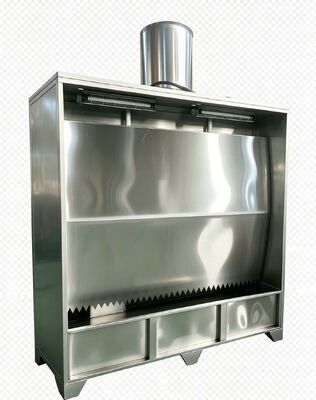
The water curtain is formed by a curved stainless steel plate. Water is pumped to the top and flows down the face of the plate; the curvature keeps the film attached to the surface and spreads it evenly across the full width, rather than letting it channel into rivulets at the edges.
At the top of the plate, the overflow edge is cut with a serrated (saw-tooth) profile. The teeth divide the incoming flow into a large number of small, evenly spaced streams, which is what produces a continuous sheet instead of a few thick ropes of water. An even sheet has far more contact area for the same flow rate — and contact area is what capture efficiency depends on.
In practice, the combination of a curved plate and a serrated weir is what keeps the curtain unbroken at low pump speeds, and an unbroken curtain is the single most important thing in this type of equipment.
BUILT-IN LIGHTING AND TOP EXTRACTION
Two lighting tubes are mounted inside the upper section, behind the work opening, so the work face is lit from within the enclosure rather than by workshop lighting from outside. Colour assessment and coverage checks are done where the part actually is.
A cylindrical extraction outlet on the top of the cabinet connects to the workshop's exhaust ducting or to a fan set. Drawing air upward and out through the top, past the water curtain, keeps the airflow path across the operator's work and away from their breathing position.
04 APPLICATIONS & SPECIFICATIONS
TYPICAL APPLICATIONS
Sample panels and colour approval swatches
Small metal components, castings, brackets and hardware
Furniture touch-up, repair and small cabinet parts
Helmets, housings, plastics and consumer goods
Laboratory, quality-control and R&D spraying
Prototypes and short runs in workshops without a full booth
|
Parameter |
Specification |
|
Equipment |
Compact water curtain spray cabinet |
|
Construction |
Stainless steel 【confirm SUS304 or SUS316】 |
|
Collection tanks |
3 — staged settling, isolated drain per tank |
|
Curtain plate |
Curved stainless steel, full-width water film |
|
Overflow weir |
Serrated (saw-tooth) profile for an even sheet |
|
Lighting |
2 tubes, mounted inside the upper enclosure 【confirm LED and rating】 |
|
Extraction |
Top-mounted cylindrical outlet to ducting or fan set |
|
Front |
Open-front work opening |
|
Base |
Four support feet 【confirm height and adjustability】 |
|
Water circuit |
Recirculating pump, staged tanks 【confirm pump kW and flow】 |
|
Exhaust airflow |
【confirm m³/h】 |
|
Workpiece |
Small to medium parts handled by hand |
|
Customisation |
Width, tank arrangement, pump capacity, lighting and outlet diameter engineered per order |
05 FREQUENTLY ASKED QUESTIONS
Q: What is a water curtain spray cabinet used for?
A: It captures overspray from hand spraying of small parts, samples and touch-up work. The rear wall carries a continuous film of flowing water; overspray is drawn into the water, captured and settled into a tank, instead of staying airborne or clogging a dry filter.
Q: How is a compact cabinet different from a full water curtain spray booth?
A: Scale and intended duty. A compact cabinet suits small parts handled by hand at low or intermittent volume, and fits where a permanent booth cannot be installed. A full booth suits continuous production, larger parts, conveyor or rack handling, and higher extraction volumes. The capture principle is the same; the capacity is not.
Q: Why three tanks instead of one?
A: Staged settling. Solids drop out in the first tank before water passes onward, so cleaner water returns to the curtain plate. That extends the interval between clean-outs, keeps the water curtain unbroken, and lets each tank be drained and cleaned without emptying the whole circuit.
Q: What does the serrated overflow weir do?
A: It divides the incoming flow into many small, evenly spaced streams so the water leaves the top edge as a continuous sheet rather than a few thick ropes. A continuous sheet has far more contact area for the same flow rate, and contact area determines how much overspray the curtain actually captures.
Q: Does it need to be connected to ducting?
A: The cabinet has a top-mounted cylindrical extraction outlet, designed to connect to your workshop exhaust ducting or to a fan set. Where no ducting exists, CoatTech can supply a matched fan and filtration package.
Q: Can it handle solvent-based paints?
A: Yes, and this is where a water curtain earns its keep — the water film traps sticky solvent overspray that would rapidly load a dry filter. For solvent work, confirm the fan motor and lighting are specified to the explosion-proof rating required by your site and coating flash point.
Q: What information do you need to quote?
A: Part dimensions, coating type with TDS/MSDS, expected daily or weekly volume, available floor or bench space, and whether you have existing exhaust ducting plus a water supply and drain.
06 TALK TO OUR ENGINEERING TEAM
Send us your part dimensions, coating type and expected volume. We will confirm whether a compact cabinet suits your work — or tell you honestly that a full booth would serve you better — and return a configuration with a budgetary proposal.
![]()
![]()