| MOQ: | 1 |
| Price: | USD2000-USD10000/SET |
| Standard Packaging: | With regular Film and Carton |
| Delivery Period: | 15 DAYS After Deposit |
| Payment Method: | T/T |
| Supply Capacity: | 500SET/MONTH |
01 WHAT THIS PAGE IS ABOUT
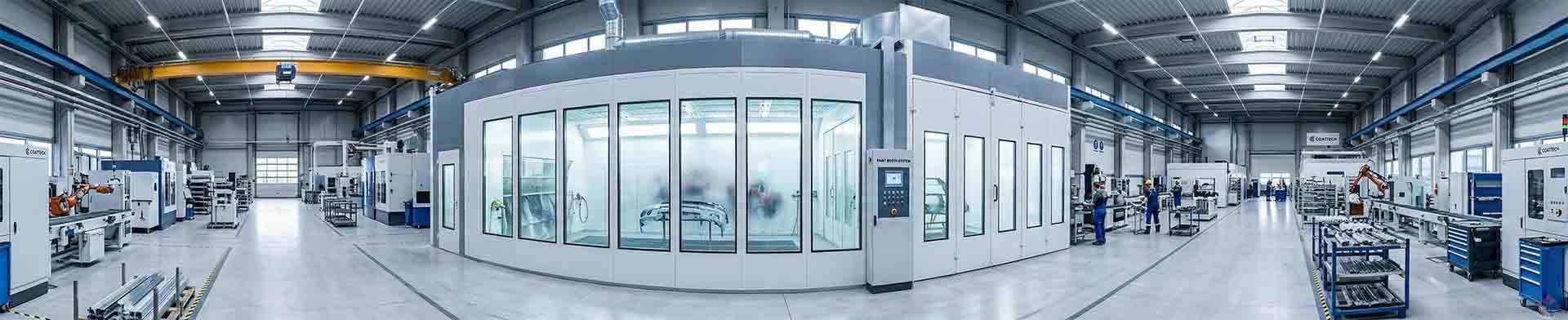
An automatic electrostatic powder coating booth is an enclosed cabin in which charged powder is applied to a grounded metal workpiece by fixed or reciprocating spray guns, while the part moves through on a conveyor. Overspray is contained, captured and returned to the feed system rather than released into the workshop.
Most powder coating lines are designed around parts that fit on a hook: brackets, extrusions, panels, wheel rims. Container-type enclosures are a different problem. A large industrial container, shelter or special-purpose housing may be several metres long, several tonnes in weight and deep enough that its interior corners behave as a Faraday cage. The equipment has to be engineered around the workpiece, not the other way round.
This page sets out what changes when the workpiece is that large: fixturing and load, gun coverage over a tall face, powder behaviour in recesses, airflow inside an oversized cabin, and the curing capacity that has to match it.
WHEN THIS CONFIGURATION IS THE RIGHT ONE
· The workpiece is too large or too heavy for manual spraying to cover consistently
· Parts are produced on a repeatable cycle rather than as one-off jobs
· Film thickness has to be held within a specified band across a tall, broad face
· Powder recovery and a clean working environment are part of the requirement
· The booth must connect to pretreatment, curing and cooling in one continuous flow
HONEST NOTE For very low volumes, highly varied geometries or frequent colour changes on short runs, a manual or semi-automatic station may be the more economical answer. CoatTech will say so if that is the case.
![]()
02 THE FOUR ENGINEERING PROBLEMS
2.1 FIXTURING AND LOAD
A large enclosure cannot simply be hung from a standard hook. The suspension point, the centre of gravity and the sway of the part as it travels all have to be resolved before the conveyor layout is fixed. Fixtures are designed so that the part is presented square to the guns and does not rotate or swing while the reciprocators are stroking. Conveyor load, pitch and speed are specified from the actual workpiece, not from a catalogue rating.
2.2 COVERAGE ACROSS A TALL FACE
A single fixed gun leaves banding on a tall panel. Reciprocators move the guns vertically through a controlled stroke, and their speed is synchronised to the conveyor speed so that each pass overlaps the previous one by a consistent amount. Stroke length, stroke speed, gun spacing and powder output are set together; changing one without the others is what produces striping and uneven film build.
On an enclosure with side walls, roof and end frames, gun positions are arranged to address each face in turn, with manual touch-up stations retained for edges and returns that the automatic pattern cannot see.
2.3 RECESSES AND THE FARADAY CAGE EFFECT
Electrostatic powder follows field lines, and field lines do not reach easily into deep recesses, internal corners or box sections. On a container-type housing this is the most common cause of thin coverage. The response is a combination of lower voltage and higher powder delivery at the recess, closer gun stand-off, dedicated manual pre-touch on internal returns, and reduced line speed; it is not simply more powder. This is why the geometry of the part has to be reviewed at quotation stage.
KEY LINE: the geometry of the part has to be reviewed at quotation stage — not discovered during commissioning.
2.4 AIRFLOW AND RECOVERY IN AN OVERSIZED CABIN
A larger cabin means a larger air volume to keep under control. Extraction is sized from the booth opening area and the required capture velocity, then checked against the gun cloud, so that powder cloud is held inside the cabin but not pulled so hard that it distorts the spray pattern. Overspray is captured by a cyclone and secondary cartridge filter bank, sieved and returned to the feed hopper. Recovery rate and colour-change time are stated in the proposal for the actual configuration.
03 SYSTEM CONFIGURATION
A typical line for container-type enclosures comprises:
· Loading and fixturing station with workpiece-specific jigs
· Pretreatment stage, spray or immersion, matched to the substrate
· Moisture drying oven
· Automatic electrostatic powder booth with vertical reciprocator slots on both sides
· Manual touch-up position for recesses and returns
· Cyclone and cartridge powder recovery with sieving and return to the feed centre
· Curing oven sized to the full envelope of the workpiece
· Cooling and unloading
· Central PLC control synchronising conveyor speed, gun triggering, stroke and oven temperature
WHY IT MATTERS Control is recipe-based. Once the parameters for a given enclosure are set, the line repeats the same gun output, stroke and line speed on every part, which is what removes the shift-to-shift variation that manual application cannot avoid.
04 SPECIFICATIONS
|
PARAMETER |
SPECIFICATION |
|
Equipment |
Automatic electrostatic powder coating booth for oversized enclosures |
|
Workpiece |
Container-type industrial housings, shelters and special-purpose enclosures |
|
Workpiece envelope |
Engineered to the workpiece — confirm max L x W x H and weight at quotation |
|
Conveyor |
Overhead or floor-rail, load and pitch engineered to the workpiece |
|
Gun arrangement |
Automatic reciprocators both sides, plus manual touch-up station |
|
Stroke and speed |
Vertical stroke synchronised to conveyor speed, PLC recipe control |
|
Powder recovery |
Cyclone separator with secondary cartridge filter bank, sieving and return |
|
Recovery rate |
Stated in the proposal for the actual configuration — confirm at quotation |
|
Airflow |
Sized from booth opening area and required capture velocity |
|
Booth material |
Anti-static engineered panel or stainless steel, specified to the coating |
|
Curing |
Oven sized to the full workpiece envelope; heating source per site utilities |
|
Control |
Central PLC touchscreen with recipe storage and diagnostics |
|
Power supply |
Specified to destination country |
|
Customisation |
Booth dimensions, gun layout, fixtures, conveyor and oven engineered per order |
NO INVENTED NUMBERS Every uncertain parameter is written as engineered-to-order. Keep it that way — a guessed figure is the fastest way to lose a technical buyer.
![]()
05 FREQUENTLY ASKED QUESTIONS
Q1 Can you powder coat a container-type enclosure in an automatic line?
A Yes, provided the booth, fixtures, conveyor and curing oven are all sized to the workpiece envelope. The limiting factors are not the guns but the load and sway of the part, the stroke length needed to cover a tall face without banding, and the oven volume needed to bring the whole assembly to cure temperature. These are resolved at the layout stage.
Q2 What is the Faraday cage effect in powder coating?
A Charged powder follows electric field lines, and field lines do not penetrate easily into deep recesses, internal corners or box sections. Those areas receive less powder and can end up with thin coverage. It is addressed with lower voltage and higher delivery at the recess, closer gun stand-off, dedicated manual pre-touch on internal returns and reduced line speed, not simply by increasing powder output.
Q3 How do automatic reciprocators avoid striping on tall panels?
A By synchronising stroke speed to conveyor speed so that each vertical pass overlaps the previous one by a consistent amount. Stroke length, gun spacing, powder output and line speed have to be set together. Changing one in isolation is the usual cause of banding, and recipe storage on the PLC keeps a proven set of parameters repeatable.
Q4 How much powder is recovered and reused?
A Overspray is captured by a cyclone and a secondary cartridge filter bank, then sieved and returned to the feed hopper. The achievable recovery rate depends on the configuration and the colour-change strategy, so CoatTech states the figure for the actual proposed system rather than quoting a generic number.
Q5 Does the curing oven need to be larger than the booth?
A It has to accept the full workpiece envelope with clearance for airflow, and it has to hold the whole assembly at cure temperature for the required dwell time. For a large thermal mass this often makes the oven the stage that sets the line speed, so oven sizing and conveyor speed are decided together.
Q6 What information do you need to quote?
A Maximum workpiece dimensions and weight, substrate and coating specification with TDS, target film thickness, required parts per shift, colour-change frequency, available floor space and ceiling height, and the utilities at your site. CoatTech will return a process layout and a budgetary proposal.
06 TALK TO OUR ENGINEERING TEAM
Send us your workpiece drawings, weight, coating specification and target output.
We will return a line layout covering fixturing, reciprocator positions, airflow, recovery and oven sizing, with a budgetary proposal — including an honest answer on whether an automatic line is justified for your volume.
Youtube Video Link as follow
https://youtube.com/shorts/9l0gJpL52jc
![]()
![]()
|
|
| MOQ: | 1 |
| Price: | USD2000-USD10000/SET |
| Standard Packaging: | With regular Film and Carton |
| Delivery Period: | 15 DAYS After Deposit |
| Payment Method: | T/T |
| Supply Capacity: | 500SET/MONTH |
01 WHAT THIS PAGE IS ABOUT
An automatic electrostatic powder coating booth is an enclosed cabin in which charged powder is applied to a grounded metal workpiece by fixed or reciprocating spray guns, while the part moves through on a conveyor. Overspray is contained, captured and returned to the feed system rather than released into the workshop.
Most powder coating lines are designed around parts that fit on a hook: brackets, extrusions, panels, wheel rims. Container-type enclosures are a different problem. A large industrial container, shelter or special-purpose housing may be several metres long, several tonnes in weight and deep enough that its interior corners behave as a Faraday cage. The equipment has to be engineered around the workpiece, not the other way round.
This page sets out what changes when the workpiece is that large: fixturing and load, gun coverage over a tall face, powder behaviour in recesses, airflow inside an oversized cabin, and the curing capacity that has to match it.
WHEN THIS CONFIGURATION IS THE RIGHT ONE
· The workpiece is too large or too heavy for manual spraying to cover consistently
· Parts are produced on a repeatable cycle rather than as one-off jobs
· Film thickness has to be held within a specified band across a tall, broad face
· Powder recovery and a clean working environment are part of the requirement
· The booth must connect to pretreatment, curing and cooling in one continuous flow
HONEST NOTE For very low volumes, highly varied geometries or frequent colour changes on short runs, a manual or semi-automatic station may be the more economical answer. CoatTech will say so if that is the case.
![]()
02 THE FOUR ENGINEERING PROBLEMS
2.1 FIXTURING AND LOAD
A large enclosure cannot simply be hung from a standard hook. The suspension point, the centre of gravity and the sway of the part as it travels all have to be resolved before the conveyor layout is fixed. Fixtures are designed so that the part is presented square to the guns and does not rotate or swing while the reciprocators are stroking. Conveyor load, pitch and speed are specified from the actual workpiece, not from a catalogue rating.
2.2 COVERAGE ACROSS A TALL FACE
A single fixed gun leaves banding on a tall panel. Reciprocators move the guns vertically through a controlled stroke, and their speed is synchronised to the conveyor speed so that each pass overlaps the previous one by a consistent amount. Stroke length, stroke speed, gun spacing and powder output are set together; changing one without the others is what produces striping and uneven film build.
On an enclosure with side walls, roof and end frames, gun positions are arranged to address each face in turn, with manual touch-up stations retained for edges and returns that the automatic pattern cannot see.
2.3 RECESSES AND THE FARADAY CAGE EFFECT
Electrostatic powder follows field lines, and field lines do not reach easily into deep recesses, internal corners or box sections. On a container-type housing this is the most common cause of thin coverage. The response is a combination of lower voltage and higher powder delivery at the recess, closer gun stand-off, dedicated manual pre-touch on internal returns, and reduced line speed; it is not simply more powder. This is why the geometry of the part has to be reviewed at quotation stage.
KEY LINE: the geometry of the part has to be reviewed at quotation stage — not discovered during commissioning.
2.4 AIRFLOW AND RECOVERY IN AN OVERSIZED CABIN
A larger cabin means a larger air volume to keep under control. Extraction is sized from the booth opening area and the required capture velocity, then checked against the gun cloud, so that powder cloud is held inside the cabin but not pulled so hard that it distorts the spray pattern. Overspray is captured by a cyclone and secondary cartridge filter bank, sieved and returned to the feed hopper. Recovery rate and colour-change time are stated in the proposal for the actual configuration.
03 SYSTEM CONFIGURATION
A typical line for container-type enclosures comprises:
· Loading and fixturing station with workpiece-specific jigs
· Pretreatment stage, spray or immersion, matched to the substrate
· Moisture drying oven
· Automatic electrostatic powder booth with vertical reciprocator slots on both sides
· Manual touch-up position for recesses and returns
· Cyclone and cartridge powder recovery with sieving and return to the feed centre
· Curing oven sized to the full envelope of the workpiece
· Cooling and unloading
· Central PLC control synchronising conveyor speed, gun triggering, stroke and oven temperature
WHY IT MATTERS Control is recipe-based. Once the parameters for a given enclosure are set, the line repeats the same gun output, stroke and line speed on every part, which is what removes the shift-to-shift variation that manual application cannot avoid.
04 SPECIFICATIONS
|
PARAMETER |
SPECIFICATION |
|
Equipment |
Automatic electrostatic powder coating booth for oversized enclosures |
|
Workpiece |
Container-type industrial housings, shelters and special-purpose enclosures |
|
Workpiece envelope |
Engineered to the workpiece — confirm max L x W x H and weight at quotation |
|
Conveyor |
Overhead or floor-rail, load and pitch engineered to the workpiece |
|
Gun arrangement |
Automatic reciprocators both sides, plus manual touch-up station |
|
Stroke and speed |
Vertical stroke synchronised to conveyor speed, PLC recipe control |
|
Powder recovery |
Cyclone separator with secondary cartridge filter bank, sieving and return |
|
Recovery rate |
Stated in the proposal for the actual configuration — confirm at quotation |
|
Airflow |
Sized from booth opening area and required capture velocity |
|
Booth material |
Anti-static engineered panel or stainless steel, specified to the coating |
|
Curing |
Oven sized to the full workpiece envelope; heating source per site utilities |
|
Control |
Central PLC touchscreen with recipe storage and diagnostics |
|
Power supply |
Specified to destination country |
|
Customisation |
Booth dimensions, gun layout, fixtures, conveyor and oven engineered per order |
NO INVENTED NUMBERS Every uncertain parameter is written as engineered-to-order. Keep it that way — a guessed figure is the fastest way to lose a technical buyer.
![]()
05 FREQUENTLY ASKED QUESTIONS
Q1 Can you powder coat a container-type enclosure in an automatic line?
A Yes, provided the booth, fixtures, conveyor and curing oven are all sized to the workpiece envelope. The limiting factors are not the guns but the load and sway of the part, the stroke length needed to cover a tall face without banding, and the oven volume needed to bring the whole assembly to cure temperature. These are resolved at the layout stage.
Q2 What is the Faraday cage effect in powder coating?
A Charged powder follows electric field lines, and field lines do not penetrate easily into deep recesses, internal corners or box sections. Those areas receive less powder and can end up with thin coverage. It is addressed with lower voltage and higher delivery at the recess, closer gun stand-off, dedicated manual pre-touch on internal returns and reduced line speed, not simply by increasing powder output.
Q3 How do automatic reciprocators avoid striping on tall panels?
A By synchronising stroke speed to conveyor speed so that each vertical pass overlaps the previous one by a consistent amount. Stroke length, gun spacing, powder output and line speed have to be set together. Changing one in isolation is the usual cause of banding, and recipe storage on the PLC keeps a proven set of parameters repeatable.
Q4 How much powder is recovered and reused?
A Overspray is captured by a cyclone and a secondary cartridge filter bank, then sieved and returned to the feed hopper. The achievable recovery rate depends on the configuration and the colour-change strategy, so CoatTech states the figure for the actual proposed system rather than quoting a generic number.
Q5 Does the curing oven need to be larger than the booth?
A It has to accept the full workpiece envelope with clearance for airflow, and it has to hold the whole assembly at cure temperature for the required dwell time. For a large thermal mass this often makes the oven the stage that sets the line speed, so oven sizing and conveyor speed are decided together.
Q6 What information do you need to quote?
A Maximum workpiece dimensions and weight, substrate and coating specification with TDS, target film thickness, required parts per shift, colour-change frequency, available floor space and ceiling height, and the utilities at your site. CoatTech will return a process layout and a budgetary proposal.
06 TALK TO OUR ENGINEERING TEAM
Send us your workpiece drawings, weight, coating specification and target output.
We will return a line layout covering fixturing, reciprocator positions, airflow, recovery and oven sizing, with a budgetary proposal — including an honest answer on whether an automatic line is justified for your volume.
Youtube Video Link as follow
https://youtube.com/shorts/9l0gJpL52jc
![]()
![]()